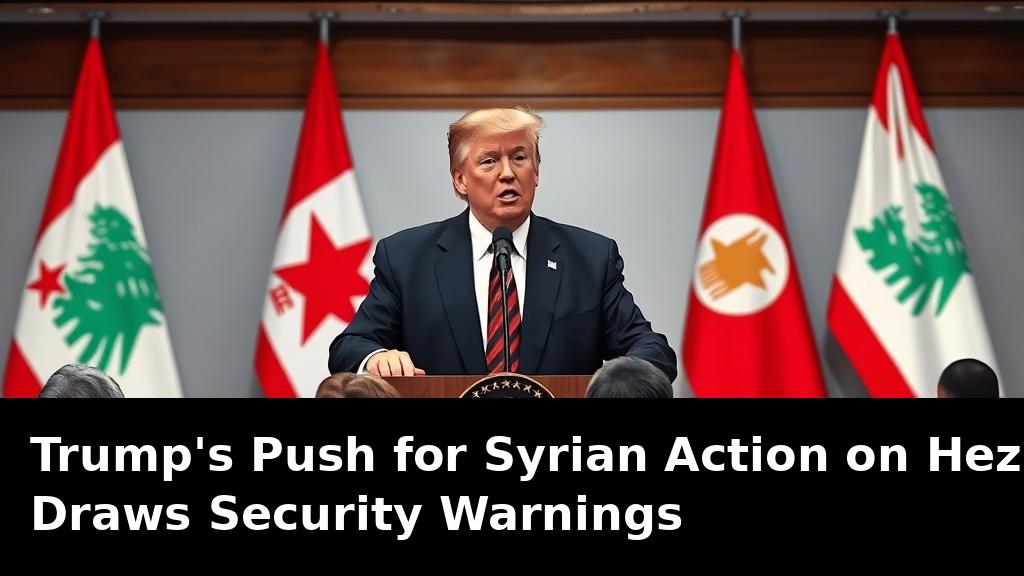


US President Donald Trump’s reported pressure on Damascus to confront Hezbollah in Lebanon has prompted analysts to caution that the approach risks weakening Syria’s internal stability.
The call comes amid ongoing regional tensions, with Washington urging Syrian authorities to extend influence beyond its borders. Observers note that such intervention could divert resources from rebuilding efforts inside Syria after years of conflict.
Domestic security in Syria remains fragile, with various factions still active in different provinces. Forcing external military commitments might strain government forces already tasked with maintaining order at home.
Background on the Lebanon-Syria dynamic shows longstanding ties between Damascus and groups operating in Lebanon. Any shift in this relationship would require careful calibration to avoid spillover effects across the border.
One key analysis point is the potential strain on Syrian reconstruction priorities. Resources allocated to external operations could slow infrastructure repairs and economic recovery programs currently underway in major cities.
Another point concerns the risk of renewed clashes within Syria itself. Analysts highlight that opposition elements might exploit any perceived overextension by government forces, leading to fresh instability in regions that have only recently seen reduced violence.
Regional actors are closely monitoring developments, aware that changes in Syrian policy toward Lebanon could alter power balances involving multiple neighboring states. This interconnected web makes unilateral moves particularly sensitive.
The overall assessment suggests that short-term geopolitical gains may come at the expense of longer-term stability inside Syria, a trade-off that policymakers in Damascus will need to weigh carefully against domestic needs.